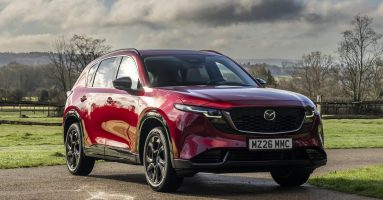
Buying a new electric luxury car must be one of the great acts of faith in modern times.
Maybe it’s not as great an act as was the case when doubts about EVs in general drove trade-in values into the ground.
But all that negativity appears to have abated. There is a renewed confidence abroad judging by latest figures.
But because there are still relatively few enough buyers at the top end of the EV market and a disproportionately large volume of brands, every purchase is cherished.

So it has been, and remains, a tough old game even for the legacy brands, many of whom have relied on longtime loyal associations with internal combustion engines to help hesitant buyers cross the EV line.
And there is/will be the Chinese to set the fox among the pigeons, with keen prices to appeal a new audience for them.
For a still emerging brand such as the Polestar, all these factors make life that bit tougher.
Yet, it’s fair to say that the former underling to Volvo has come a long way, despite setbacks.
It takes time for niche cars, as Polestars are, to become recognised as an option for a luxury vehicle.
I’ve just been driving the latest from the Scandinavian brand. The low-slung SUV Polestar 3 starts from €92,890, including delivery. And to give it its full name, it is the Polestar 3 Long Range Single Motor Plus. The Plus bit is important in terms of spec and performance.
Apart from the price, it is something of a minimalist by nature – as are most Polestars.
Design and shape lines – often the measure of how daring larger EVs can be to look at – are more than subtle in the ‘3’. You have to get up close and personal to find them.
And even then, there is little to shout about, except that there is something about the ‘stillness’ of the car in terms of looks on the outside and minimal, but by no means austere, décor within that makes its own statement.
There is nothing really stirring the soul or prompt emotion. Well, not for me. But I’m sure buying customers are into the idea that it can be cool to show you prefer quiet and low-key. I can see how they’d like how décor follows the natural contours of the cabin, for example.
It certainly is a contrast to some of the daring EV looks wrought by Mercs and Beemers to name but two. I have to admit I love the look of some of them.
One area where all feel they have to perform is on the driving dynamics.
And that’s where, underneath the Polestar’s visual quietness, comes the drive itself.
When I took the first sortie, focus shifted from design to the slick, near silent deliver of power. This near non-conspicuous Polestar 3 Long Range Single Motor Plus, with its 111kW battery, dished lots of power and bred confidence over zig-zag Wicklow mountain roads.
It tucked in well when the corners got tight, slowed without the tail-twitch you sometimes get when braking hard, and it picked up and sped away without wasting a second.
There’s plenty of practicality. My car has a claimed distance of up to 706kms on just the one charge. I’m not surprised it won a world record for its ‘real-world’ capability.
I won’s say it outguns the best of the comparable Beemers and Mercs on handling and ride but it does in most cases convey it was set up to deliver a drive with a different slant. Some of the ‘3’ range models have air suspension: mine had BWI passive dampers with coil springs. It was a tad below exciting on that front.
Its 0-100kmh acceleration time isn’t bad at 7.8 seconds for a rear-wheel drive EV and neither is 220 kW (299 hp) to unleash it with serious torque (pulling power) 490 Nm.
I have to repeat, it was noticeably silent.
Public DC charging can handle up to 350 kW and from 10per cent to 80 per cent in 22 minutes, while Home AC charging from 0per cent to 100per cent will take 11 hours.
Polestars carry the standard EU Type 2 connector, which is compatible with Ionity, as well as stations from epower, ESB and Weev, and more than 600 other providers.
I felt every second of the first sprint to 100kmh. It may not have been similar to the official test figures but it conveyed a certain dynamism. Which is what Polestar want it to have. Much of their identity is based on this being attractive.
Just as important as the on-road alacrity, in many ways, is the ability to quickly it replenish energy: 10per cent empty to 80per cent full – in just 22 minutes – thanks to the 800v architecture.
And helpful in keeping the distance between stops at a decent interval is the presence of a heat pump which warms up the cabin by using run-off thermal energy from the battery, electric motors and ambient air.
I found the official range figures to be closer to real world than I expected. Definitely not as unrealistic as some. Kilometres covered and energy remaining almost matched each other side by side over the length of my time at the wheel. Hence that world record I mentioned.
Some of the credit must go to those driving cars like this and who do so in moderation. Apart from the few accelerative zips here and there I drove in middle distance mode most of the time. There was also a fair bit of tiddling around town which as you know is where an EV works best.
Polestar here say that most ‘3’ customers are currently driving a premium SUV (including ICE, PHEV and EV). Interesting to see what customers are trading in: they include the likes of the BMW X5 and iX, Mercedes EQC, Audi e-tron and Lexus RX.
It is hardly surprising that its main rivals are the BMW iX, Audi Q8-tron and Tesla Model Y, with the specific model I tested in most demand right now.
While the cabin is minimalist, there is a good sprinkling of spec. That includes a Bowers & Wilkins 1,610-watt sound system and headrest speakers, active road noise cancellation and infrared windscreen, heated rear seats, Pilot Assist with Adaptive Cruise Control and 360-degree camera parking system. It’s a comprehensive lineup of stuff but rivals fare well in that department too.
Of course, no review of a Polestar would be complete without mention of using ‘sustainable’ materials. Natural fibre composites, recycled aluminium and textiles abound. They say it is 85 per cent recyclable at the End-of-life stage.
Scandinavian minimalism and mindful materials you might say (Polestar do).
They also claim high scoring on the tuned suspension (maybe a few points below that for me), and low battery placement (lends itself to stability).
There is generous room back and front, helped by the impression of space thanks to that ‘minimalist’ design. The seats were excellent; I felt right comfy with their support.
But the boot, albeit with two floor levels, isn’t huge.
Important to note there is a three-year/100,000km guarantee on parts and an 8-year or 160,000kms warranty if the battery’s state-of-health drops below 70per cent of its original capacity.
It’s a cliché to say those who want something different will consider it – but that is the case with the ‘3’. The package also works because there are relatively small clusters of Polestars here at this point in Ireland so you get a degree of exclusivity in small numbers.
And that could work in your favour as you would expect the car to hold its value at a decent point in the deprecation league.
Of course, it could work a bit the other way too where legacy brands might be seen as a better bet.
Somehow, even thinking like that seems to make buying a luxury SUV less of a leap of faith than before.