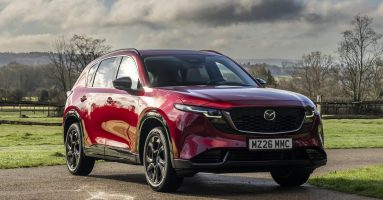
Should you by any chance be trawling the market for a small electric hatch, take a minute for your own amusement – amazement – at how two cars can look so different yet be so similar.
The Nissan Micra and Renault 5 have totally different body panels.
But, their platform, batteries, motors and nearly everything that moves are exactly the same.
It is a classic bit of design strategy by the Renault-Nissan-Mitsubishi alliance: build the same underpinnings (Renault’s AmpR Small EV platform) – which by and large you can’t see – and radically change how the car looks – which you can see – and save a lot of money making both.
There is something the same or similar nearly everywhere. There are 10.1ins driver’s displays and a 10ins central infotainment system with built-in Google Maps and Google Assistant.
Take away the exterior panels and those inside screen displays and all you’re left to cater for are a couple of cubic metres of cabin space.

I fear I’m reduced to pointing out tiny snippets – such as the design of the infotainment being different.
The Micra trim, some might say, is a bit more muted. I disagree. I prefer the less vibrant seat colours and materials.
While some buyers will agonise on such points, brand loyalty will play a big part too, especially if you have been buying from the same dealer for some time.
I’ve already reviewed the Renault so the basis of this review is primarily about the Micra, though mention of the ‘5’ is unavoidable.
The Micra has two batteries: a 40kWh and a 52kWh.
And three trims: Engage, Advance and Evolve
The less powerful battery Engage model goes with the entry price (from €25,995) but it is joined with the more powerful 52kWh version for the mid-trim ‘Advance’ model.
I think that’s the car to go for. It has the best mix. The entry level is too constrained by range, while the range-topper ‘Evolve’ comes only with the 52kWh battery and is all dressed up with the likes of a mega sound system. Not so sure I’d pay the extra for some of them.
The range is structured, as it is, to cope with different budgets and needs.
Entry level is grand if you would normally use a car for shorter runs – around town, school trips, to work and back etc.
They (WLTP) claim you’ll get to up to 317kms on this. It’s much nearer to 285kms you’ll find, including divine intervention.
It would be a good option (there are several rivals about which that could be said) for a second family car, or a drop-down from a bigger vehicle for a couple or a single owner.
The 52kWh battery, claimed to have a range of 416kms is a different proposition. I criss-crossed downtown Dublin with it several times on a miserable Sunday evening recently, after doing a fair few jaunts on city streets during the week.
I was surprised that my 52kWh test car was enroute to 390km without replenishment. It did a hell of a lot of driving. Bumper to bumper stuff. If I didn’t have to take it on the M50 twice I reckon it would have just topped the 400km mark. That’s a great return. Just remember it was 90 per cent town driving.
If you are travelling further than usual and you need a boost, the cars can accommodate DC fast-charging up to 80 kW (for 40kW model) and 110 kW for the 52kW.
I’ll quote the physical dimensions to show the Micra has decent height (it is 1,498mm tall), 3,974mm long (that helps rear-seat space), 1,830mm wide (no elbows clashing) and has a wheelbase of 2,541mm which facilitates boot capacity of 326 litres. That’s not bad for a small car.
I don’t know if I’d go for the circular lights on the Micra. I’d have liked something different.
They jarred a little with the look of the front.
I do know that I greatly preferred, and used, the regenerative braking paddles on the Micra’s steering wheel. The Renault 5 didn’t have that when I drove it some time back.
I have no doubt my excellent return figures were due in large measure to judicious use of the paddles. Not to mention that bit more control over how I wanted to drive.
One thing I wondered about was the old-fashioned set-up where there is a clutter of stalks and buttons – and buttons underneath the stalk under the steering wheel, where it can be tricky to find and operate the likes of audio controls for higher or lower volume. Those buttons have been on Renaults for years and look quite dated. Nimble fingers needed.
Rivals include the ‘5’ of, course, the Citroën ë-C3, Fiat Grande Panda, Peugeot e-208, BYD Dolphin, MINI Cooper electric.
The first of the three grades (Engage) takes on a good, reasonable dollop of spec but, like so many others, you know that the cost of manufacture played its part in having 18ins steel wheels as standard. That’s the way of the competitive auto world.
You also get privacy glass, a nod to a rear spoiler, heated/electrically adjustable wing
mirrors, high beam assist and cloth seats.
Important, and I often forget it, is the presence of two rear ISOFIX points. There’s a polyurethane steering wheel, and 4-way manual driver/front passenger seats.
Vehicle dynamic control + traction played some role, no doubt, in lending stability and grip though my minutes on the sort of road that would need it were minimal.
It was a simple, straightforward drive in town; equally on the main roads.
Just thinking back with all my driving, that it isn’t so long ago that cruise control/speed limiter was executive-car class material. Now it’s standard.
The same goes for driver drowsiness and attention alert as are traffic sign recognition, lane departure warning, emergency lane keep assist etc.
One of the first things I look for is rear parking sensors. It has them. You need them for the tight, shrinking spots to squeeze in.
There is 11kW AC charging, 80 kW DC charging, mode 3 cable, and a heat pump helps the main battery; 7ins colour TFT, 10.1ins infotainment screen with CCS 2.0, CCS2/Apple CarPlay/Android Auto, full i-key/anti -theft, e-Pedal, air con, 1x12v outlet, 2xType C USB ports.
The Advance spec model (40kWh and 52kWh, from €27,995) adds 18ins alloys (yeah) and two-tone metallic paint.
The seating was good, solid and there was reasonable manual adjustment built in.
As time goes by you notice the spec differences with the Renault trim (which I remember was vibrant). There’s a sport cabin trim in this Micra grade, nonetheless. And a heated leather steering wheel; more parking aids with front/rear sensors, rear view camera and flank protection. Capable of 110kW DC charging (52 kWh battery). There’s 10ins colour TFT, sat nav, wireless charger, driving modes, electric parking brake and the e- Pedal.
With top-spec Evolve (€32,995, 52kWh) you get two-tone metallic sport interior trim, heated
driver and front passenger seats, adjustable/2-way lumbar for driver, rear-view camera, premium harman/kardon sound system with 9 speakers, ProPILOT, one pedal stop with paddle shifter.
Would I buy it? Yes: the 52kWh version. Nice cabin. Family friendly. Good energy return, solid feel and decent spec.
No: A couple of things weigh against it: that clutter of buttons and stalks, the perception that men don’t buy or drive Micras. I’m sure that’s not true but . . . .
Overall: Go on, confuse yourself and look at the Renault as well. It’s a tight battle.