The dreams go on for the Chinese BYD auto maker.
They are ratcheting up the launch numbers despite being here only a few short years.
Recently they’ve added volume and variety of power to its electrified range. And I drove two of the new plug-in hybrids.
Their Super Hybrid (DM-i) system uses a 1.5-litre petrol engine to feed a large battery so the motor can drive the wheels.
The engine supplies power to the battery and the motor turns the wheels. It works like a generator.
Would it be fair to say BYD are correct to claim that with judicious driving, you should be able to go in electric mode a fair chunk of the time.
Yes, without doubt if you are mindful, vigilant, and take your time.

The engine kicked in at strange times with me. It wasn’t when I’d have accelerated to overtake or go up a hill when you’d imagine that would be the time the petrol boost would be needed. If the battery was sufficiently full at the time, there would be no need for a boost. So, the engine could work any time.
You have to get your head around the fact that the engine goes to work only when the system alerts it. That’s when I would hear the whrrrrrr of the engine starting to work.
They have brought in two versions of this PHEV: ‘Comfort’ and range-topping ‘Design’ trim – even though there isn’t that much between them on critical points – or on price.
The entry-level Comfort costs €36,990; for €4,000 more you get the Design spec (€40,990). I was driving the latter.
No doubt the strategists have done their homework: €4,000 might be a gap too far for those on a tight budget. Or it might be perfectly sound for someone trading down.
It might also suit those looking for a longer session driving on pure EV.
BYDs Super PHEV make much of fast charging times – from 20per cent to 80per cent in 23 minutes or so minutes on a DC public charger and from 2.7 to 6 hours for a full charge at home depending on battery size and charger.
It’s important to remember that the system power output remains at 212hp for both. Comfort’s battery capacity is 12.96kWh. That’s capable, they say, of travelling 62kms on pure-electric range. An overall WLTP combined range figure of 992kms is fantasy stuff for this plug-in. But say you got 600/650kms out of it: would it not be an option? You have EV driving and petrol backup.
The larger 18.3kWh battery that comes with the Design model has a pure-electric claimed range of 85kms and a combined range of 1,016kms. Official consumption figures go from 2litres/100kms – 2.7itre/100kms. Not in a month of Sundays. Acceleration at 0-100kmh in 8.1 puts it in the moderate class.
There’s a lot of stuff to drag around, you see, not least the petrol engine (especially when full). Which may, in part, explain why these hybrids haven’t taken off to any great degree. Other manufacturers (Nissan) have had similar set-ups but they failed to impact.
However, given the favourable tail wind that BYD has at the moment, who is to say they won’t renew a trend?
The question is would I or should you buy it? We’d probably wait until we’d see more of them on the road.
One attraction for me would be cabin space and the main reason for that is the 2,712mm long wheelbase.
The car itself is 4,738mm long, 1,860mm wide and 1,710mm tall. There was decent room, head, leg and elbow at the back.
I’d be attracted by the better spec levels. The entry-level Comfort spec has it as standard. I also liked the look of the 18ins alloys.
The 12.8ins infotainment screen worked ….. okay. It can be difficult to see the smaller type on lower parts of the screen if there is strong sunlight; the 8.8ins digital instrument panel is better.
I don’t know about you, but I’m finding electrically adjustable front seats a necessity rather than an extra. Both models get it as standard. Equally necessary are rear parking sensors. Ah! the Design model gave me front parking sensors as well as a 360-degree camera. I even admired my own input – well someone has to steering and brake it. Heated front seats (were welcomed but not by me).
The important issue for families is boot capacity. With the boot upright, there’s 463-litres but that extends to 1,410 litres when the 40:60-split rear seats are folded.
Rivals such as the MG HS (PHEV) have from 441 to 507 litres depending on model. The Ford Kuga (PHEV) – 581 to 645 litres; Kia Sportage (PHEV) – 540-litres. Nissan Qashqai (e-Power Hybrid) – 504 litres.
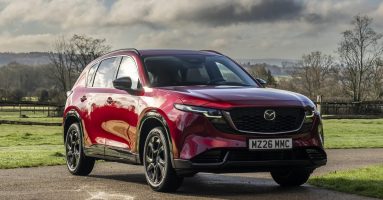
The BYD Sealion looks like so many cars from China: smooth, curved front with lights in premium position, typical low-key badging and heavily boosted wheel arches flares.
The Hi BYD voice commands are still not great, patchy I’d say.
Finally, there is warranty cover for the cobalt-free, lithium-ion phosphate Blade Batteries of 8-years or 250,000kms.
And there is the extensive suite of safety and driver assistance (ADAS) – we mostly forget about them even though they are the most important elements in keeping us safe and the car in one piece Unfortunately, the ADAS suite of safety items is forgotten or merely noted in passing.
But knowing you have them can be a great reassurance.
Would I buy it? Yes for the potential of driving so much on EV, high spec levels and overall practicality. It is a fine package.
No, for the glitchy bits and pieces.