The speed at which new electric and ‘electrified’ cars are sweeping into the market here is, surely, good news for seller – and used-car seller and buyer.
It’s fair to say we haven’t had so many battery-electric vehicles (BEVs) on sale in our short, betimes bloody, introduction to electric vehicles (EVs) the rise and rise of the electric car.
The good thing about that is, there are more compact models to meet demand for lower prices EVs. Much of the negative vibes were about larger, powerful EVs that lost their value sharp and severely. I still hear of some outrageously low trade-in valuations.
Those apart, the growing level of competition surely should keep prices pegged?

It is interesting to watch how more marques are beginning to make a flow of new second/third generation EVs, full hybrids, mild-hybrids and plug-ins.
The likes of Hyundai, a wave of Stellantis’ models and the Volkswagen group cars imminent or just on the market are only some vying for more sales on the back of increased model varieties.
Another one of note is KIA. It is setting a ripping pace; partly planned, partly imposed by stretched production lines.
And they have plenty more to come judging by what they’ve been tell us.
Virtually all are electric (BEV), or electrified but they’re still selling lots of non-EVs. Just like the Kia Sportage. The subject of this week’s test is the EV5 SUV. It is slated to take over the Sportage big seller at some time in the future. Not for a long time say KIA. Not when the evergreen SUV is selling so well (35per cent of all new Kias sold last year).
Taking a backward glance of what has come so far, it is revealing and a bit of fun to see how much the new KIA ‘look’ has picked up through the brand. The theme is ‘Opposites United’ as I’m sure you know only too well at this stage. It blends the strong, chunky look and the more subtle turns of line and edge.
It means the brand has its own identity like never before. The EV9 giant, the EV4 hatch-back model, are just two examples of the strong design and the impact it can make on the profile of a large and small car alike. The EV3 is another.
Even the slightly obscure ‘KИ’ delineating brand lettering doesn’t seem to have stopped too many from buying. But, for all that, I still think the strong lines are not be to everyone’s taste. I suppose it would be strange if everyone loved it.
So that’s the context of the EV5 tested.
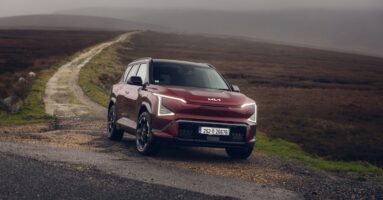
The outside is typical of that new-age KIA already mentioned. There were a few ‘soft lines’ around the side and rear but it never let me forget it was a big, blocky machine – there I’ve said it.
Gloriously or ingloriously in-your-face.
Just take a look at those rugged wheel arches, the thickness of the pillars, the broad snub nose. Ok, that’s enough looking.
From any viewpoint this is blessed with space, pace and spec. And you pay accordingly.
Space and spec are the more important of the trio but it was nice to get a bit of spice out of it too. Being the tallest in its class should have meant it would flop around a bit when the roads got a bit grumpier. It didn’t – well not much. It handled bends and narrow, choppy roads more than adequately for such a big vehicle. The paddles behind the steering wheel let you select a preferred level of brake-energy regeneration.
It was big on comfort; strong seating supporting back and thighs.
Big is a word to describe the interior too. My GT-Line had soft-touch materials all over the cabin and around the dash but lower there are some dull-ish grey plastics down.
You’ll get great room. When the rear seats (they have a metre of space) are folded completely flat there is a two-metre expanse of a loading area. At 566 litres the EV5’s boot is above average, while there are several storage slots, including the ‘frunk’ which holds a tad more than 44 litres.
People may criticise the pricing (from €47,625 to €54,000) and rightly so. Yet it’s a bigger car than some rivals (straddles the C-SUV and the D-SUV segments) and they do ladle on the spec. So do some of the plusher rivals – such as the Skoda Enyaq.
The EV5 has 4,615mm length, 1,875mm width, 1,715mm height, and a 2,750mm wheelbase to provide the dimensions on which to exploit the interior room.
Despite that it yields on length, but not necessarily inner room, to the Tesla Model Y (4,751mm). It is on a par or longer than other rivals such as the Ionic5, Škoda Enyaq iV, Nissan Ayira, Renault Scenic E-Tech and VW ID.4.
One thing that worked in my favour was being able to ‘step’ up into the cabin – it is a tall machine –without having to crouch.
With good adjustment on the steering wheel, it took me no time to lock in the comfort.
A 81.4kW long-range battery and 160 kW motor are standard. They say it’s capable of covering up to 530kms; my estimation over my test drives a second time round, was 485km.
I’ve got that mostly with just two passengers on board and no heavy shopping or travel bags (for a change).
I’m sure my regenerative braking and the help of a heat pump made a difference to consumption too. Half an hour gets you 80per cent energy replenished from 10per cent.
The screen display area is huge. Really impressed with that. In essence there are three displays sharing a wide over-screen with the 12.3ins digital instrument cluster – from which it was clear and easy to garner info. Then there is the 5.3ins touchscreen for climate control functions and the main infotainment display (12.3ins) which was easy to use.
Happily, they held on to the concept of what I thought were a few buttons for practical things. But then I realised there were a lot of them. Loads. I suppose it’s better than having to drive yourself crazy delving into the innards of their digital equivalents. And, sensibly, the further-away ones you’d use only now and again. The main active buttons lie in the centre of the dashboard under the air vents.
But I just don’t like where they have the starting button – in behind the steering wheel and over a bit. Surely they can find a more comfortable home for it.
Out on the roads, the EV5 displayed a forgiving nature when it came to badly finished surfaces, and held well on corners that had poor camber. For a big bus, that was good going. Not tyre-smoke stuff but energetic enough.
Kia’s intent to get a few more steps up the upmarket ladder is everywhere. Heated front and rear seats are standard, they’ll tell you. But there is are bits of grey, dull plastic.
And across the range, the next-gen battery heating/cooling function heats the cabin more efficiently. They’re up to the minute on over-the-air (OTA) updates; there’s a digital key 2.0, fingerprint recognition and smart cruise control 2 (SCC2). There is a lot of stuff.
I drove (this test) the top-ranger GT-line. Earth 2 is the entry level trim and Earth 3 the middle child.
As I mentioned the entry Earth 2 has the heated seats throughout, cloth/ leather seats, LED headlights, 18ins alloys, smart power tailgate etc.
The Earth 3 spec is more to my liking. It adds full leather seats with front ventilation, interior ambient lighting, 19ins wheels and dynamic welcome lights.
My test trim (GT-line) version had a massive glass roof that helped brighten things on a couple of dreary rain-filled days. For the driver there is a seat massage function and scattered here and there are GT-Line styling cues, head-up display, Vehicle-2-Load (V2L) adaptor, and digital key with fingerprint recognition.
The EV5 will cost you €47,625 for the Earth 2 entry-level model; Earth 3 from €49,800 (I think it is worth the few euro more; and the GT-Line costs €54,000. No, there is no four-wheel drive option.