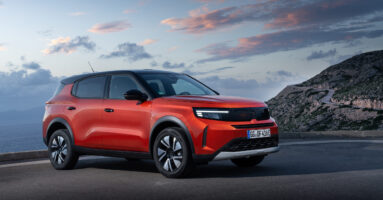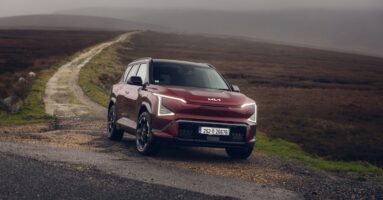
I’d love to have been a fly on the wall when they were marking out how the new Opel compact SUV – the Frontera – was designed and put together.
Like every car, I’m sure it is a compromise of sorts.
Such a car can be based on another’s platform, use some of its parts, use its switchgear and power sources.
That all holds true for the Frontera.
As part of the auto giant Stellantis, it has a multitudinous menu of parts, engineering, hardware, software and much more from which to pick and choose – so long as the chosen elements are in line with the budget they want the car to do and represent.
As far as the Frontera goes, it seems they have a way to make a virtue of compromise.

Take the cabin, for example. It’s minimalist, within a hair’s breath of being spartan. Yet even with a few skelps of hard-wear plastic materials around, it doesn’t impose any bleakness on you. It makes it a touch funky. Well, that’s how I saw it.
Remember to get the Frontera into the populous segment that they decided they want to reach for sales numbers (no compromise there) they are constrained by that thorny old bottom line – at least for the entry-level models.
As a result of all that, the Frontera is among the relatively few compact SUVs that could take on Dacia – the Jogger 7-seater is the key rival – in the bargain department.
The basement is not the place you’d expect to find an Opel, though they did make a few dips into the battleground now and then across the years.
It is clearly aimed at Dacia’s 7-seat Jogger on pricing (optional seven seats) but it doesn’t look nearly as low key. And apart from looking better than the Dacia, it has an EV model in its lineup while the Jogger doesn’t.
Strong exterior colours and a sparse/minimal cabin help keep the Frontera’s street-cred economy and family appeal.
The arrival of seven seats in the Frontera – there is a 5-seater too of course – will give young families something to think about. The Opel’s stablemate the Citroen C3 Aircross can also take seven seats by the way. Demand for a ‘7’ in any segment is always fairly keen, given how many times I’ve had families ask about them.
They can be God-sends for those needing more room for little bodies and/or luggage or shopping. Flatten the second or third rows and you’re in decent luggage carrier territory. But passenger space isn’t as great in the second row as might first appear. And the two seats on the third row are for the toddlers.
As well as the mild hybrids, there are two full-electric model with different outputs. The electric version costs from €24,606 and the mild hybrid model from €27,995.
Just take note: You have to go to the top-rung €33,595 GS petrol mild hybrid to get into a 7-seater.
The Frontera is smaller than the Jogger and shorter by 16cm (4.55m v 4.38metres) but wider and taller than the Dacia. There is also more luggage space in the Dacia. But what can you expect from the Frontera? The laws of physics don’t compromise on length and size in a compact SUV.
Considering that, they’ve done well with the Frontera. As much as 460 litres of luggage can be stored in the boot. Fold the second-row of seats and you get up to 1,594 litres.
A little more on the cabin. It has a tidy, unfussy nature about it. Materials were reasonable to the touch – well, there was few plasticky spots down under – but overall inoffensive.
Being a tall-ish SUV there was a definite sense of spaciousness.
I liked the digital cockpit and the way the screens stretch across the dash. And how, in my test car, I still could keep an eye on the core information directly between the steering wheel spokes.
I’m not sure about the silver/bronze surrounds, however. And it could do with a physical button for the radio.
The Intelli-seats in higher-spec models did make a difference to lower back and lumbar regions.
I’m sure you know but the mild hybrids have a small electric motor to help the engine. Unlike the full hybrid they can’t really drive on pure electricity. Full hybrids have larger batteries and motors and can drive on battery power for as much as 60per cent on urban traffic.
The mild-hybrid petrol I had on test – the motor is integrated into the gearbox – did show moments of strain. There was a clunkiness and slow response when parking on a slope, in particular.
I felt the combination of 6-speed auto gearbox and 28hp electric motor could have done better as a team. It was as if one lagged behind the other.
In its favour, however, the ‘hybrid’ worked quietly to return 5.9-litres/100km over varied surfaces. A 44-litre tank will go a decent distance.
In the recent past, engineers at the Stellantis Group reclassified the 1.2 hybrid 136hp as having an output of 145hp.
There are wide-opening rear doors for ease of access for passengers and baby seats.
As much as 460 litres of luggage can be stored in the boot. Fold the second-row of seats and you get up to 1,594 litres of room.
Roof rails are optional. The 60/40 split rear bench seat and second load floor ensure versatility.
This is where it gets interesting. See how the entry-level (SC) trim includes 16ins painted steel wheels – to cut cost. It’s a good example of where they make a virtue out of what would otherwise be an object of criticism. That’s what you could call positive compromise.
There is manual climate control, a10ins driver information display, a smartphone station and the usual list of safety must-haves: rear park assist, cruise control, lane keep assist, forward collision alert, driver drowsiness alert, and speed sign recognition.
Second-level trim, hybrid Elegance costs from €30,095. There is a noticeable lift in price and what you get with this model. For example, there are heated front seats/steering wheel, 17ins alloys, automatic climate control, a10ins HD touchscreen with navigation, DAB radio, wireless charger, front USB type C connection, rear view camera, driver and front passenger Intelli seats. And there is a welcome, middle console with front centre armrest and hidden storage.
Range topping GS trim (from €28,354 with grants for the electric version) or from €32,095 for the petrol hybrid, adds front and rear park assist, roof rails, a black roof, high gloss black door mirrors, black front Opel logo, rear privacy glass, power folding rear view mirrors, electro-chrome rear view mirror, and LED foglamps etc.
The 7-seater GS petrol hybrid model (from €33,595) costs €1,500 more than the equivalent 5-seater (from €32,095).
The same gap holds true for the more powerful 7-seater (145hp, €34,595).
No compromise there: it’s one or the other. It will be interesting to see how the 7-seater fares.