The motoring business is like a merry-go-round that never stops. Soon we’ll have the July second coming of new cars.
Dealers are taking orders. There are deals to be done. And it always helps to have a fresh new motor on the forecourt.
Jeep, for one, should be happy with the timing of their new Compass SUV launch this week.
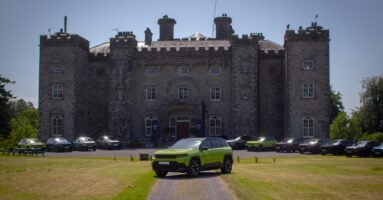
If they are as lucky with the sales as they were with the weather and location at the launch (blue skies and Slane castle as the illustrious backdrop) then they’ll do well.

But one dazzling day does not make a summer. It can’t be the Royal green fields and sumptuous surroundings every day.
Neither does one new Jeep make a brand successful.
They would be the first to admit they have encountered the cold climate of rejection by many looking for, and expecting, better.
They will be hoping, nonetheless, that the new mid-size Compass, will give a lift to the brand as it joins the likes of the Avenger in a major push by the brand.
It was ironic (to me anyway) that the new SUV looks like a modern-day take on one of the rivals out there that come under the mistaken name of ‘jeep’.
It has strength in design. The element I liked most was the bit of a kick up the rear (of the car) they have given it.
There’s more than the look of a scaled-down Land Rover Discovery or the EV9 from KIA. And depth along the sides give it a chunky, if not funky style.
Overall, it’s got a bit about it. Certainly, better than what’s gone before.
But, as ever, you stand still at your peril in this market and Compass rivals have pushed on too, so making up ground is going to be challenging.
The C-SUV segment in which it resides is the ‘hottest’ of them all. Internal combustion rivals, for example, include the KIA Sportage, Hyundai Tucson, Volkswagen Tiguan, Nissan Qashqai etc.
EV rivals include its Stellantis stablemates the Peugeot e-3008 and Opel Grandland; Skoda Enyaq, Tesla Model Y, Kia EV5.
To give credit where it is due, Jeep has put a strong package together. It is not without its faults, of course. For now the lineup includes and e-hybrid and a EV
Bigger all round, they have exploited the longer wheelbase to real room inside.
The cabin in our test car was notably roomy, front and back. You will get a toddler and two adults across the rear where passengers get an extra 20 mm of legroom. There are several little stow slots which stretches to 34 litres. Boot space adds 45litres more (to 550 litres) than before.
Key dimensions are similar for both the e-hybrid and EV in most cases. It is 4,548mm long, 1,904mm wide, height at roof rails is 1,904mm and there is a 2,784 wheelbase – the basis for so much room inside.
It wouldn’t be a Jeep if we didn’t have approach and departure angles of 20degrees and 26degrees respectively. Ground clearance is 200mm, water fording 408mm, 470mm (EV).
Comfortable seating, good adjustment of front seat/steering-wheel yielded a fine driver view. I needed it because the bonnet seemed to stretch a long way out.

Some of the materials felt a bit plasticly especially on the flat part of the dash and down low.
Despite that, standard spec and equipment from entry level (Altitude) look decent – from adaptive cruise control to a fix-and-go tyre repair kit. Worth noting is that hybrid and electric versions cost the same.
I like most of what Stellantis, who own Jeep, have done with their coherent, contained infotainment, nav and display system. The Compass is a key beneficiary. It is not flashy but it looked right at home in the mid-dash slot devoted to it. Furthermore, it works easily.
The cloth/vinyl seats we had on test wouldn’t be my preference – purely on colour. A bit grey but it’s no big deal: just get another combination. They should be easily kept clean too given the fabrics used.
They must be expecting a cold snap. Nearly everything you touch or see can be warmed. I exaggerate, but there is heated seating, steering wheel and windscreen, electric folding heated mirrors and 2-zone air con.
Parking sensors front/back and a rearview camera take the strain out of getting into a tight spot; then there is the Select-Terrain function, and 18ins alloys with summer tyres.
Full electric versions at this trim (Altitude) level get 19ins wheels with summer tyres, pre-conditioning for auto air con, a Mode 3 charging cable and 11kW on-board charger.
They reckon First Edition spec will be changed/dumped but officially additions over Altitude trim include 7-slot illuminated grille, privacy glass, front/rear fog lights, roof rails, wireless charger.
Full electric versions at First Edition trim get 20ins alloys with summer tyres and hands-free power liftgate.
The mild-hybrid, or e-hybrid entry powertrain has a 1.2-litre, 3cyl petrol engine that can work up a 145hp head of steam.
It took a while to do so, however, as we found on stretches of main roads and motorway driving. Perfectly alright for a family, of course. Let’s not lose the run of ourselves; it is a family vehicle.

But a little more punch would do wonders for it. If you are looking for more pep an electric version would be a serious option. Or wait for one of the more powerful models expected here later.
Powertrains planned for the new SUV include a 145hp 48v e-hybrid, a 195hp e-hybrid plug-in and three full-electric versions, ranging from a 213hp front-wheel drive version up to a hell-raising 375hp all-wheel drive. Such additions will give an entirely different perspective to the range. There is certainly plenty to look forward to there, for sure.
We didn’t push too hard on any aspect of our test drives over mostly good roads. On a few stretches of poor surface there was nothing much of road noise. The steering was particularly light regardless of driving mode. Yet it didn’t affect or disrupt my input of changing lanes or overtaking.
There’s a Selec-Terrain switch within easy reach and you can invoke five driving modes: Auto, Sport, Snow, Sand/Mud, and, Electric (e-Hybrid Plug-in version).
Incidentally all current models on the price list are front-wheel driven.
The current e-hybrid 1.2-litre model emits 127g/km C02- 129g/km Co2 depending on version and consumes a claimed 5.6 litres every 100kms. Altitude spec costs from €42,995, with First Edition models from €45,995.
There is a 74 kWh battery in the EV version (213hp) and it consumes an average of 17.5kWh/kWh – 18.2 kWh/100km. It can, they say, cover 477kms-498kms on one full battery. Not a chance. The Altitude EV costs from €42,995, and the First Edition from €45,995.
The EV is no slouch on charging time. A rapid 160kW DC means you get a 20-80per cent recharging time of 30 minutes. As mentioned current models are claimed to be capable of covering nearly 500kms. A home charge, 0-80per cent, takes eight hours.
An extended range version comes later with up to 650 km of range.
It may look a bit blunt but having an active grill shutter integrated into the front bumper, a fully flat underbody, the air duct on all wheels, sharp rear edges etc help the aerodynamics.
One initiative I liked from last year was their deal, first introduced on the Jeep Avenger, to allow customers who choose electric to switch to a hybrid powertrain within 90 days if they feel a fully electric model is not the right fit for them.
There is a five-year warranty and free home charger for EVs.
So, can the new Jeep Compass point the way to better times? It is early days but the portents are good.