I know Alfa Romeo have had their doom days but you have to hand it to them, and the Stellantis auto giant to which they belong, for rejuvenating the historic brand once again.
I’m sure it has been far from easy for all involved to get more of that old Alfa spring back in its step. And to get the badge on a smaller-car option.
They obviously recognise the need to attract a wider, younger, audience. And so, the self-explanatory name Junior range was born.
I have driven, be it for a short trip or a week-long stint, the core electric models at this stage but the Ibrida mild-hybrid version is the one I tried out last as it was a late arrival but not as late as my review of it (apologies to all).

The power comes from the 1.2-litre 3cyl turbo-charged engine which we know from the Stellantis stable. It is assisted by a 21kW electric motor and 0.9kWh (0.5kWh net) lithium-ion battery pack.
That combination has been widely used by Stellantis stablemates. If you are driving certain versions of the Citroen C4, Jeep Avenger, Fiat 600, Peugeot 2008, or the Opel Grandland, Peugeot 5008 and Citroen C5 Aircross, chances are some of you have that core engine under the bonnet.
The mere fact that there is such a spread of models shows there is life in the small petrol turbocharged engine yet.
In the case of the Ibrida’s engine it ably assists in making the Junior a sufficiently attractive proposition for anyone buying for the new year who is not yet inclined to go full electric.
But there are plenty of ‘nice’ cars out there around the same size and price range. The Ibrida ‘hybrid’ starts at €34,995, matching that of the entry-level electric model but road tax is €180, compared with €120 for the electric cars.
Anyway the pressure is very much on to convince younger drivers in particular that this is the car for them.
It has been my experience that cars like the Ibrida either charm you on first acquaintance or not.
For me, there were good initial vibes. I also think it’s a good thing to have the EVs and mild-hybrid looking largely similar. If you were to line up the cars side by side, you wouldn’t notice much of a difference between them; the rear exhaust outlets for the engine of the hybrid are the big give-away.
Otherwise, you get the shield-shaped grille, hidden rear door handles that give it a smooth coupe look and some clever detailing.
It’s not a big car. It probably looks larger than it is: It is 4,173mm long, 1,781mm wide, 1,539mm tall and has a wheelbase of 2,557mm. That gives it a little more height than the Elettrica or the Veloce models but the wheelbase is 5mm shorter.
And giving it a driving edge is the front-wheel-drive via a 6spd dual-clutch automatic gearbox which I hardly even noticed thanks to it doing its job nice and quietly.
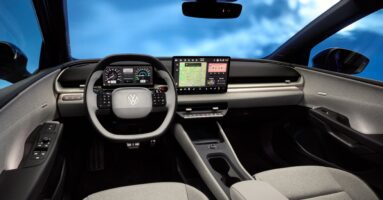
Inside is cleanly and smartly laid out.
There is a nice feel to the seats and upholstery but the seats were a bit tight for me. Obviously they would better suit a younger, more svelte, frame.
Much of what goes on the dash is Stellantis product (gear selector column stalks, drive mode, rocker control are all Peugeot, Citroen etc heritage). Nothing wrong with that, though it might put off some buyers looking for a more ‘Alfa’ approach.
They get to do that with the rest of the dash: The 10.25ins digital cluster in Alfa’s own graphics, fonts and rev counter, set it apart. Which is what so many carmakers strive for in a world of so many cars being built on the same platforms.
Now, I know the car is called a compact SUV and is really for two occupants out front and two at the rear but the scarcity of room in the back row is a fair degree tighter than I’d like.
Further back there is good: the 415-litre boot is 15 litres larger than either of the electric Juniors.
Regardless of its shapes and sizes, they have somehow managed to make a good job of it. You get enjoyable driving, with sharp handling.
Combined with a ride that allows a nice touch of rigidity without hammering the dampers it will go a fair bit of the way to please old and young Alfa fans.
Obviously it can’t develop as much power as the Elettrica and Veloce flagship EVs (156hp Elettrica, 280hp Veloce) with 136hp on tap but we’re talking different strokes for different folks.
We know that EVs are heavier than their corresponding ICE (internal combustion engine) and that goes for the Imbrida. Being 240kg lighter it is, if calculations are correct, one-tenth of a second quicker to 100kmh than the Elettrica.
Petrol consumption is claimed to be 4.8litres/100km. Probably a bit more under real-world conditions.
There’s a good mix of power and pace with crisp response to right-foot prompts. Not bad for a car that is a mild-hybrid not a fully charged one.
Like many others, Alfa claim it drives 60pc of the time in urban driving with the engine off. I have yet to find that to be the case.
There is a decent spread of spec, including, iconica fabric seats, six-way manual adjust on driver’s seat (4 on front passenger), 10.25ins ‘Cannocchiale’ customisable digital cluster, 10.25ins Radio – with wireless smartphone mirroring, automatic air con, adaptive cruise control, keyless start, rear parking sensors.
There is a Traffic Technology Pack (€3,500), Premium Pack(€3,000): traffic sign information, LED matrix projector headlamps, 6-speaker sound system, rear back-up camera. Other elements: Jam Assist, wireless smartphone charging pad, USB Type C port – charging 2.5A, front, rear, side parking sensors; adjustable cargo floor height (3 levels), heated seats, 6-way adjust, lumbar support/, massage. And there’s more: black painted body-kit, sports pedal, premium seats.
VERDICT
The engine and suspension conspire to make this one of the most dynamic drivers in its class.