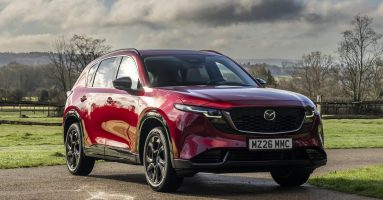
Giving motorists “equipment levels they want, at a price they can afford”, is the mantra behind Dacia’s biggest ever car, the Bigster. And while not much effort went into the naming process, Dacia has delivered again on that promise. A first glance at the Bigster, along with its sub-€30k price tag, and you may think you have stumbled upon a budget-friendly Land Rover Discovery or even a Land Cruiser. But the Bigster is more akin to its Duster sibling, with a generous serving of creatine added to the mix.

The Bigster borrows the rugged looks of the latest Duster, but is more polished around the edges. It is a good-looking SUV with acres of space, so the Bigster is sure to be a stand-out option for families. At a length of 4.57-metres and a wheelbase of 2.7-metres, the Bigster offers a boot volume of 667-litres (612-litres in the full hybrid), which can be increased to 1,912-litres with rear seats dropped. Rear seats fold 40:20:40 with a centre armrest featuring cupholders and slots for rear seat passengers’ devices. In addition, the rear seats can be folded simply using a release lever in the boot.
The Bigster is available in a choice of three trim levels, mild and full-hybrid petrol engines, plus the option of a 4×4. I did mention at the top of this review the Bigster’s sub-€30k price tag – €29,990 to be exact for the entry 1.2-litre three-cylinder petrol engine ‘Essential’ model. That comes with a 10.1-inch central touchscreen with Android Auto and Apple CarPlay, air conditioning, 17-inch alloy wheels and a parking camera as well as rear parking sensors.
Add a few more creature comforts and you are looking at the mid- to late-30 thousand Euro mark, which is still impressive value compared to most of the Bigster’s competition. On test here was the ‘Journey’ hybrid model, powered by a 1.8-litre four-cylinder petrol engine paired with a 37kW electric motor and a four-speed automatic gearbox.
The Journey trim, at €38,285, gains a heated steering wheel, heated front seats, rear window privacy glass, wireless phone charging and a power tailgate. Regardless of the spec, the cabin does house plenty of cheap plastics across the dash and doors, but the main touch points such as the steering wheel and gear selector are more up-market.
Trim dependent, the Bigster uses Renault’s new hybrid 155 engine, which we’re told offers more power and torque and less consumption than the hybrid 145 engine used in the Duster and Jogger. I drove both of those cars in the past 12 months and did notice a more refined and quieter drive from the Bigster. Fuel consumption is decent across the Dacia range regardless of engine, with this self-charging hybrid Bigster in particular returning 5.4l/100km.
The Bigster does come with a range of driving aids as standard, but only scores three stars in the Euro NCAP crash test, being marked down for adult occupants and vulnerable road users, but scoring positively for child protection in the event of a collision.
I would still maintain that the seven-seat Jogger is the best car Dacia sell in Ireland, but the Bigster makes a compelling argument against that.