I used to find it difficult to write anything about Ford’s electric cars without being critical of how the motoring giant dilly-dallied so long about committing to the idea of EVs for the immediate and long-term.
I still find it hard to understand their tardiness, but not so much as before with the likes of the Explorer, Capri EV and Puma Gen-E now on stream to help fill the gaps in their range.
Either they were being cute devils and banked on others ploughing billions upon billions into the first furrow of modern EVs (say what you like about core rivals Volkswagen they spent a fortune on developing technologies – and continue to do so).

It was a high-risk game for Ford. Had EVs gained greater market share more quickly than they did, Ford could have found themselves cast hopelessly adrift.
As it turned out they were lucky, or sufficiently terrified of falling off the wagon altogether that it was able to piggyback on the advances of others. Volkswagen, in particular, made processes and technologies available which, at least, kept the blue oval badging on their electric vehicles.
I’ve reviewed the Capri here some time back. And this week it’s the Puma Gen-E compact SUV stepping up to the plate, priced from €32,916.
The current, conventionally powered Puma is Ford’s best-selling car in Europe, so there will be a lot of people tuning in to see what they have done with a car they have known so well as fossil-fuelled compact small crossover.
I always liked the Fiesta-based Puma. It was one of the few that excelled in transmitting sharp-handing energy to the driver. It was never what you’d call a looker but the near-crescent shape and use of strong colours mean it retains a reasonable, long-time profile.
I found it surprising that they’d go for such as small battery (43kWh) given the Puma’s sporty spirit. You are left with trying to balance driving it in conservative family mode or placing more emphasis, more frequently on the dynamics.
I suppose it’s not a bad choice to have. The 168hp electric motor lifts it to 100kmh in a claimed eight seconds which isn’t bad and I enjoyed the initial zip. The trouble is I did start looking a bit anxiously at the lowering range estimate sooner than you might if there was greater battery power available.
All of a sudden the start-out range (officially 376kms) begins to look quite short, especially when pushed.
But I got on with it. There’s no doubt it has a lot of good points, especially easy to drive and park.
I mention parking because even with monitors and beeps many a new compact SUV/Crossover driver finds it difficult to slip into slots originally made for moderate-sized saloons and hatchbacks.
Out on the road, and away from the urban madness, the Puma fared well. My only real criticism was I found the ride could be overly firm. You will notice that; it is how the suspension is set-up.
I found it most noticeable on stretches of national primary routes that have a series of short hills-and-hollows, as well as uneven surfaces on poorer back roads. But there wasn’t a bother with it on the motorways and better maintained roads. I enjoyed it. Great road feedback through the steering wheel.
One help to lower usage of battery would have been the inclusion of a heat pump on board. It looks after functions such as cooling or heating the cabin. As you probably know it can take outside air and heat cabin and battery. It can also take outside and cool the cabin and in doing so, reduce strain on the battery pack.
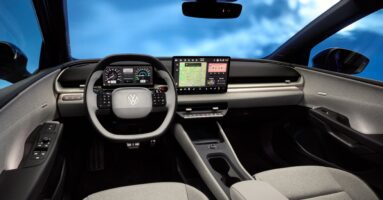
The cabin looked roomy enough. And your eyes are drawn to the large infotainment screen with lots of Ford designs. Ford have done well with its SYNC system. The Puma has elements of a well-stocked digital cockpit with its SYNC 4 infotainment, Android Auto, Apple CarPlay and Connected Navigation. It worked well on the test car.
And the seats suited me greatly. Lots of cars have quite short seats, leaving the likes of myself desperately shorn of support underneath.
It was only when two young people sat in the back that we realised there was little enough room for anyone more than 5ft6ins. It would be a nightmare for a six-footer. I used to be 6ft 1ins (6ft 1.5ins to be completely honest) but even if Father Time has shorn an inch or two off the old frame, I still couldn’t see myself being anything more than sitting back there for five or six minutes at most.
I wouldn’t get too carried away with the 376kms claimed range. You’ll probably get 320kms or so based on the quieter interludes of my test drives. That’s not bad at all in reality.
The lack of back-seat space is partially explained by the expanse of the MegaBox boot storage space to GigaBox dimensions. That makes it nearly twice as spacious as before with, Ford claim, more room for luggage than some larger SUVs. It is a big asset where a family is concerned.
So, there you have it; Ford’s answer to the many electric compact SUV/Crossovers already attracting buyers who are currently, or about to be, in a Renault 4 E-Tech, Hyundai Kona Electric, Peugeot e-2008, MG ZS EV, Jeep Avenger to mention a few rivals.
It’s not the best around and it comes a bit late to the table but it does give Ford a solid foothold in the highly competitive small SUV/crossover segment. That’s good news especially for current owners of Ford petrol and diesels.