It is difficult to overlook the new Inster electric mini SUV from Hyundai – on a number of fronts
Tall, thin and angular, it certainly catches the eye. It is the sort of car you’d pick out in an airport or shopping mall parking lot. Whether or not it is your visual cup of tea is a matter for yourself. It looks like the Suzuki Ignis with sharper lines. I liked the look of it. Others most certainly did not and lamented the demise of design.
But like it or not you will cast a second glance at it on price, value for money, spec and ability to seat four fully-fledged adults with ease in a comfortable cabin.
It has to be one of the best propositions for the €20,000, or so, you may have set aside for your next new mini-SUV. This will have you wondering if you should take the electric-car route now that there is a model on the market that meets your budget and your needs.

How Hyundai here managed to get the pricing so keen is beyond me. Basically the Inster has two battery and trimline options. The smaller of the two lineups, called the Signature, has a 42kW battery and costs from €18,995 – yes you have read it correctly €18,995 – while the 49kW larger option comes in Elegance trim and costs from €22,495. The 42 kWh battery model has a claimed range of 327km while the larger power source can manage 360km, according to the carmaker.
Even though there isn’t a lot between them on the actual distance they can cover, it is sufficient to make you think twice. The Signature version is aimed at those of us who would have it as a second car, tipping around on short journeys – while the Elegance 49kW set-up affords being a bit more comfortable in going that bit further afield.
From my driving experience, the projected distance on the amount of power remaining was quite accurate. On one chunk of my test drives, for example, it covered the equivalent of 120km driven on a calculated usage of 145km mostly in urban driving. Now that is decent. Even clipping along the M50 a couple of times didn’t knock the stuffing out of the battery like many an BEV has in the past.
I kept coming back to the stand-out figure in all of this: the €18,995 entry-level price.
I have to say I was more than surprised at the starting price and expected it to betray such a low-price tag with elements of cheapness. That was not the case. My test car spec and tech, albeit in the upper trim Elegance version, wouldn’t be out of place with a car a class above it.
I don’t think it will stay at those pitch levels for too long. But while it does it will serve to banish double whammy fears of paying too much for a new BEV while living with the fear of plunging trade-in. Surely a €20,000 BEV with the Inster’s pedigree will hold value much better.
I couldn’t help comparing it with another from the bargain basement, the Dacia Spring, which costs around €2,000 less but doesn’t have the room or spec or comfort of the Hyundai. That is not to dismiss the Dacia which is technically cheaper but it is only fair to point out the distinctions and differences.
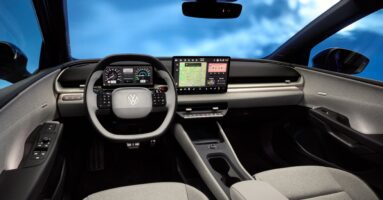
The entry-level Signature fares quite well on comfort and safety equipment in comparison with anything else in the price range. For example: smart cruise control and driver alert are part of a safety package while making the price all the more compelling are two fine 10.5ins screens (information and entertainment) with rows of buttons to help adjust the likes of heating and radio volume, a functional satellite navigation system that looks well on the screen, electric folding wing mirrors, 15ins alloys, heated seats (and steering wheel) and automatic parking brake.

Among the additions on the Elegance trim are eye-catching roof rails, the larger battery of course, 17ins alloys, a heat-pump, sliding rear bench, LED lights at the front and the rear. That’s a lot of spec for the money.
The fabric and plastics in the interior were light and bright, creating a sense of even more room; and while comfortable, they looked and felt hard wearing. My only concern would be the grey/cream colour might be easily stained.
Not only does it provide the feelgood factor of price, spec and tech, it adds a touch of fun – if only to answer questions about it from strangers.
Granted there was some tyre thump on potted roads, yet strangely for a small, tall car it didn’t lean much on bends or flop a lot over minor undulations – a boon for those back-seat passengers who suffer from car sickness. It was a lot more refined to drive than I anticipated.
Boot space is relatively small at 280 litres – what do you expect, but sliding forward the rear row increases capacity to 351 litres. That is without folding down the 50:50 split bench. If you do that, you get 1,059 litres. Pretty good don’t you think?
Rear legroom is extraordinary. Two six-footers-plus were comfortable back there with excellent headroom.
And all that within the confines of a body that is just 3.8m long, 1.6m wide making it a tad larger than Volkswagen’s little hatch, the VWup! It’s bigger than an i10 in terms of length, height and the space between its axles, but being 70mm narrower it has an unusual proportionality from certain angles.
Apart from the Spring, other near rivals include the likes of the Fiat 500-e (from €24,995) and Citroen’s e-C3 (€23,400).
And more competition has just arrived here in the form of the Renault 5 E-Tech which seriously majors on style and counters arguments that styling has gone to the dogs. It will be interesting to see how it and the Inster fare.
One thing is for certain: things will never be the same again.