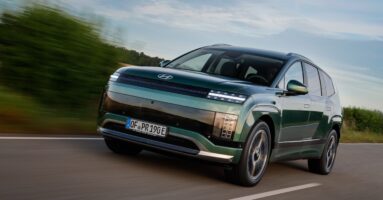
Buying a big seven-seat large electric SUV says a lot about how well some people are doing. And more luck to them. Funding around €80,000 to purchase of the likes of the 7-seater Hyundai IONIQ 9 is no simple feat for a family.
But the level of buying at that sort of money, despite some macro-economic jitters, underline a latent confidence.

It also gives a clue to the sort of needs that larger families have in transporting the young ones and their assorted sports, school bags etc, regardless of growing antipathy from the experts, politicians and an increasing ‘green’ voice. A little more on that further on.
Meanwhile those families who can afford it, carry on loving the likes of earlier arrivals such as the KIA EV9 (with whom the Hyundai shares underpinnings), the Volvo EX90 and the Tesla Model X.
There is every reason to suggest that the more recent arrival of the IONIQ 9 will not only pose a threat to those just mentioned but to others who have the size but not quite enough overall dimensions to take the crucial extra two seats. This could also expand the segment by the sheer attraction of having a car to take seven.
These two toddler-occupant extras are treasured, even if it means sacrificing cargo carrying space, because while they may not need the third row all the time, they are there when needed.
Starting from the back, then. There are 338 litres of cargo space when all the seats are up. That’s pretty decent. They reckon it means you can carry your friends and up to four golf bags. Or three full-sized 25ins suitcases. We hadn’t much by way of luggage but a heavy bout of shopping and a couple of awkward individual items weren’t long filling up the slot.
You get a lot more space (908 litres) with the third-row seats folded flat. What happens when you drop and fold the second and third rows simultaneously? You get 2,494 litres of space. That’s the sort of flexibility that makes cars like this so popular (relatively speaking; it is a still a niche market).
Here’s another example: you can take long/awkward items on board by flattening just the second and third-row seat flat on the driver’s side. It still leaves you with four seats. There is a 60:40 split for the second row (remote folding) and 50:50 for the third row. There is front storage (FRUNK) room as well.
All that is made possible by the Hyundai’s critical dimensions: 5.060mm long, 1.980 mm wide and 1,790 mm tall.
But here’s the thing. The KIA EV9 is up to 40mm lower (at 1,750mm). If I didn’t check I’d have sworn it was well taller than the IONIQ 9.
It doesn’t look. They have done well to make it a bit more like a large estate than a mega SUV. It has to do with the way the roof, wheel arches, tyres align as well as how they have flush door handles as part of the flattened-surface look to make it appear lower and sleeker.
It is a lesson in how designers can make siblings look like distant relatives. As you know Hyundai and KIA are ‘cousins’ but both have managed to distinguish themselves through styling in this case. I’m not saying the bodies don’t bear comparison. They do, in some ways if you’re bothered to take a close look. But not to a great extent. KIA’s EV9, meantime, is bolder in terms of more visible design lines – I think they make it look taller, especially when seen in that green colour that adorns the exterior.
Regardless of what’s on the outside, the IONIQ 9 looked and felt the part of executive grade materials (leather seats), screens and passenger comforts.
The main displays are now the focal point of every electric vehicle.
The panoramic curved display in the test car integrates a 12.3ins cluster for the driver and a 12.3ins touchscreen for infotainment.
It is particularly well done here: it looks classy. There was minimum need to fooster around looking for menus and no ridiculous misinterpretation on the Voice command system. I’m still surprised at how many poor systems there are – and that’s allowing for my shortcomings.
Anyway, there was no trouble with the interface and I settled in quickly on my two long-ish journeys. With good, strong, comfortable seating (they call them ‘premium relaxation’ seats for driver and front-seat passenger), as well as electric lumbar support (for the aforementioned) and ventilation that kept a nice cool breeze at face height, I slipped along with the greatest of ease.
The 20ins alloys looked smart and the tyres suited the open roads in particular.
My back-seat passenger numbers were low in the course of my time with the IONIQ 9. That only served to highlight that the second and third-row headrests weren’t doing my rear views any favours. I know it is an impossible task to account for both. Maybe even slimmer head-rests? Maybe not. Or, if not carrying more than three passengers, drop the other seats and leave not just more luggage space but rear-visibility as well. Only suggesting.
Helping their claim of a 620 km driving range is the presence of a heat pump which takes care of a number of items (heat the cabin etc) which would otherwise drain some of the main battery.
There’s a feast of helpful items around and above the cabin (panoramic sunroof for example); 14-speaker premium BOSE surround system, a 12v, 3-pin luggage compartment outlet, an encyclopaedic array of parking and reversing aids, smart cruise control etc, 5.3ins climate control system, head-up display, wireless charging pad, a huge spread of ADAS safety elements, second and third row ISOFIX anchorage second and third row.
A few things about the battery. The 620km of all-electric range version with rear wheel drive and 20ins wheels, isn’t that far off the real-world mark. So much depends on so much – weather, driver, roads, load etc. I’d say 540kms. That’s loads for any journey around the country on a full complement of battery.
This set-up can manage 350 kW at DC ultra-fast charging stations – charging from 10per cent to 80per cent state in 24 minutes.
With the V2L function (Vehicle-to-Load technology) you can power a device anywhere or charge electrical equipment up to 3.6 kW with the 230v power socket – or the exterior charging port.
Across all three rows are smartphone charging facilities (via 100-watt capable USB-C ports) with a USB-C cable provided.
And so, to the debate about large SUVs. Yes they are big, and seem to be getting bigger. And at a time when roads are shrinking – thanks to concerted efforts to squeeze the apertures to anything narrower than the traffic (horses, carriages, small motor cars) for which they were designed all those years ago. Of course, other users – cyclists, pedestrians etc are entitled to their space.
But I honestly believe planners have gone too far. Even ‘normal’ sized cars struggle to legally steer between the lines.
And then came my own situation.
We were all set for Belfast in our IONIQ9 SUV, but began to fret that it would involve driving through a narrow twisty road with cars always parked on opposite sides. I was subsequently told people are regularly called upon to move their cars so that ordinary hatches and saloons can get by.
I wasn’t prepared to endanger/scrape the car I was driving. Neither did I want to go knocking on people’s doors.
I know it was a once-off incident. We took the Toyota Yaris.
I don’t know what we’d have done if we had a 7-seat SUV.
Look, it’s too easy to make the exception the rule by giving such a single example.
But it you are going to buy one check out you’ll fit in.
Would I buy it? Yes, without a doubt.