One gets the impression that the flood of Chinese brands coming onto the Irish market can only go one way – and that’s up.
Hitching onto well-established importers and distributors gives them a great base on which to launch and learn.
And the perception, if not always the reality, that they are less expensive than some ‘home’ brands, doesn’t do them any harm.
The latest to come among us is the Leapmotor automaker.

It is being imported and distributed here by Gowan Auto which already brings in the likes of Honda, Alfa Romeo, Citroën, DS, Fiat, Fiat Professional, Jeep, Opel, and Peugeot.
With that sort of know-how and back-up it is understandable why Leapmotor plan to expand their line-up with a further six models by 2028.
Already on sale here is the T03 compact city car, and the big ‘compact’, C10 full electric and hybrid.
And so, effectively, is the Leapmotor B10 – a smaller compact SUV, here in time for January sales.
The fully electric vehicle C10 battery (BEV, 69.9kWh) has a claimed range of 424 km and it costs from €38,995.
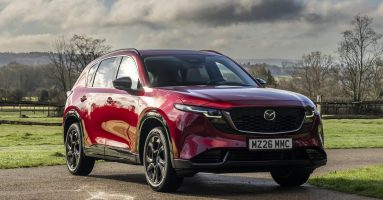
But it is the C10 REEV (Range Extender Electric Vehicle) that I want to tell you about.
It costs from €45,420. My test car: €46,995. And its rivals include the venerable Skoda Kodiaq PHEV.
Standard spec, includes ventilated front seats, 20ins alloys, panoramic sunroof, electrically adjustable heated front seats, 360-degree surround view camera, 12-speaker system, a 14.6ins central touchscreen, and 10ins digital instrument cluster. Depending on what trim you want there is adaptive cruise control, dual-zone air con, USB ports front/ back, roof rails, rear parking sensors.
The REEV is an interesting proposition. The company claims its mix of power sources can give you 975kms on one charge (28.4kWh total for battery) and one refill (50litres of petrol). I wouldn’t bet on the 975km but I would bet on getting 650kms/700kms.
The concept is simple: Engine feeds battery; battery feeds rear-mounted electric motor, and the motor drives the wheels.
You can also charge the battery from a wall socket or public charging point, just like a plug-in.
AC charging is limited to a mere 6.6kW, though you’d expect most owners will do most of their charging at home.
Using a fast DC charger is better, though, as the rate is 65kW.
The REEV formula is unusual but not original.
BMW and Mazda to name two, have used the concept. One of its chief selling points is that you get virtual EV driving ‘feel’ and response because the engine isn’t let near the wheels. It can be a little disconcerting when the engine purrs into life to feed the battery regardless of what speed you are doing. It just goes. But you soon get used to it. You can also prioritise electric driving or get the generator to maximise range – for longer journeys.
I got a lot of kilometres out of my mixed and lengthy drive and it still had a combined 650kms remaining. That puts the full-battery C10 stablemate’s 420kms in context.
But why hasn’t REEV’s forerunners been a mega seller? Why have some who sold it first time subsequently opt out? Would it suit you and meet your driving requirements more than a normal hybrid?.
So long as you don’t end up letting the battery and/or engine run flat (it is next to impossible with warning alerts). One thing is for sure: you couldn’t possibly get range anxiety with this. I never gave it a thought.
Another plus is because of the set-up, a smaller engine (1.5litre, 95hp) is enough, thereby reducing weight.
But lugging it around idle or empty is a heavyweight strain on the battery. That is one setback.
It generates 95 hp (70 kW) but, naturally, the electric motor delivers a lot more power. The result is the total system power climbs to 215 hp (158 kW). Battery size is just 28.4kWh.
You may be disappointed the learn that the REEV manages 145kms/150 kms solely in electric-only mode. The rest of the time it dinks in and out of EV-mode as the battery is primed to take the engine’s energy to maintain it. In that sense it is like a plug-in but still covers more ground in EV mode than most plug-ins. And as with plug-ins, you can recharge the battery using a home Wallbox, or the public network for example. DC charging allows for a 30-80 per cent top-up in half an hour.
Another major selling point is the room in the REEV’s cabin. Especially rear legroom, which arises from the 4,739mm length of the car. It is also 1,900mm wide and 1,690mm tall (think Tesla Model Y). Boot space at 435 litres is poor.
My test car had eye-popping Brown/Orange seats and upholstery. I wouldn’t buy it.. The glass roof only highlights the interior’s brash tan but it does brighten the cabin. There are other colour options.
Outside it looks better than some of the rivals from China. And it is better equipped to deal with most road types here. Like BYD models (Build Your Dreams) it favoured a ‘cell-to-chassis’ approach. This does not apportion the battery into modules. And that leaves more passenger space and stiffens the body for better handing and ride.
You’ll fit three across the back if the middle seater is small. Tight but doable.
The chain of command is controlled by a 14.6ins touchscreen. It was patchy, I felt. There were no buttons per se. There are little rollers on the steering wheel for adjusting volume, audio etc.
When I tried to change seat heating or ventilation, I nibbled the seat icon at the bottom of the touchscreen. It did my head in until I bullied it into submission. If you want to change something within the infotainment screens, you have to scroll through a tiring number of menus.
In fairness, the main controls are reasonably logical but the built-in navigation is particularly unclear and easily upset.
The REEV has an interesting way of getting into the car. Your tap your card on a spot on the door-mirror.
There are three regeneration settings; and there’s the one-pedal mode.
Despite some questionable bits of the infotainment displays and workings, there is a more than decent SUV in there.
It will face tough competition from across the spectrum of ‘compact’ SUVs.
And the REEV costs a good few thousand euro more than its full BEV as I’ve said. That, along with the minuses I have put against it as well as the lack of acquaintance with the name, might dissuade potential buyers from parting with their money. I can see that.
Equally, I can see that for someone in the market for a big ‘compact’ SUV with a mega range between replenishing might see this as being well worth a try.