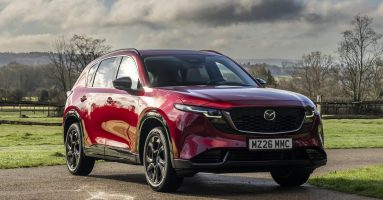
Mazda are either a little bit mad, exceptionally brave or blessed with foresight that has escaped the rest of us.
It has made a car that, on first perusal, is way off the mark as far as most people would be concerned. The combination of a voluptuously large SUV body and a heavy-punch 3.3-litre 254hp diesel engine under half an acre of bonnet is surely anathema to the vast majority of potential customers who want to be perceived to buy ‘clean and green’.
But Mazda are resolute and convinced that there are sufficient quantities, relatively speaking, of possible customers still out there to not alone delightedly buy the new CX-80 seven-seater for its room and style but would also relish the thought of having a diesel engine humming quietly while it soaked up the kilometres.

It is a well-known fact that, as a wannabe premium brand, they want to take sales from the likes of BMW. In this case they believe they can nibble at the X5 market as a demonstration of their belief that they can win over buyers thinking about changing from, or upgrading to, an executive-class SUV.
That’s the ‘mad’ thing I just mentioned but they have some things in their favour. They have a huge edge on pricing for the larger, upmarket rivals (from €62,380 for the PHEV as opposed to €100,924 for the BMW counterpart) for the well-equipped 8spd all-wheel-drive entry-level plug-in. But the diesel version, which I drove, is vastly less expensive (from €73,940 and ranging to €81,990) while the BMW costs a whopping €137,834. How ‘mad’ is that?
In fairness, I think they will have to wait a while to get transfers from the German giant or other biggies such as the Audi Q7 and Mercedes GLE.
And while they wait, there are others such as the Volvo XC90 in their sights (from €99,895).
But really the action is far more likely to focus on a variation of plug-ins, diesels (not too many) and petrols such as €63,300 for the KIA Sorento, Skoda Kodiaq (from €55,850), Peugeot 5008 range (from €50,995) or Hyundai Santa Fe plug-in from €66,995.
It’s worth noting that some of the plug-ins can only manage to get you into a 5-seater, or offer a third row as an option because the larger batteries eat up the boot space.
So, there are plenty of options, decisions and price ranges to consider.
I think the best thing about the CX-80 is the inside, though I would warn you that the brighter upholstery could take a bit of minding. Go for something dark; the cabin will still be bright enough.
The luxury vegan leather lifts the quality feel of the cabin as well as bleached wood inserts and brushed aluminium. That’s the sort of look-and-touch that heightens the quality feel of the material and it is all done alongside a great sense of practical space and comfort.
You get several flexible seating options. For example, you can pick a second-row bench 7-seater or a 6-seater dual captain’s chairs ‘walk-through’ arrangement. Third-row room is only fair but, if not in use, you can slide back the middle row and stretch those legs. But when in use, there isn’t a lot of room for luggage. That is the case for many a ‘7-seater’ but they remain popular because they afford options for a growing family.
With all rows occupied there is only 258 litres of luggage space. That expands to 687 litres with the third row down and to 1,971 litres with the second row flat.
Extremely large rear doors and a slick device that folds and slides the bench seats forward meant getting into the second or third rows was no big deal but I’d leave the last row for the younger generation to claim it as their rightful place.
The cockpit control centres were simple and easy to use, with just the right amount of digital tech. It would have been so easy to overdo the fancy stuff with a 12.3ins infotainment screen at your fingertips. Even better, it was great to see traditional buttons for the air con and volume.
Whatever about tempting buyers away from rivals, there must be every expectation that a sizeable number of current CX-60 owners will give this serious attention.
The decision would be mainly on room (the CX-80 stretches to just under five metres) and price. There is a fair gap: from €73,940 as opposed to €65,240. And extra space because the CX-80 is based so much of the smaller car.
It shares suspension, dashboard, styling, platform, technology and engines. The main difference is that it is 250mm longer. And all that extra length goes to the wheelbase which accounts for more passenger room. It is also taller.
It is surprising the difference in perception that arises from the longer wheelbase.
I have always liked the CX-60. It was large enough to cater for the average family but compact enough to travel and handle well.
The CX-80 is a different beast despite its close alliance with little brother. It felt bulkier and demanded more of a driving input from me.
Out on the motorway to and from Belfast especially, it was grand and comfortable though we made few demands on space. I thought the engine, with its mild hybrid technology, was a bit uneasy when I looked for a bit of acceleration. There was a perceptible ‘nudge’ effect which could be annoying at times.
It was only when we came back and subsequently drove over uneven roads that I noticed the softness of the suspension. It jarred a bit on such roads and took from the drive.
The Mazda Mi-Drive system – Normal, Sport, Off-road and Towing mode – lets you play around with the car’s reaction to the settings as well as engage with practical needs.
The car is absolutely jammed with tech and spec. Even the entry-level version is laden with it.
There was tri- zone climate-controlled air-con, rear door integrated sunshade, keyless entry, heated/electric/folding door mirrors, several USB slots, Pre-crash safety: Smart Brake Support Rear (SBS-R) and Rear Crossing (SBS-RC), front/rear parking sensors, hands-free electric tail gate, rear roof spoiler, exterior garnish (wheel arch, side skirts, front and rear lower bumper), ISOFIX child seat anchorage attached to outer rear seats, cruise control, several airbags, driver monitoring, blind spot monitoring, Traffic Sign Recognition. Infotainment included Amazon Alexa car integration, 20ins alloys.
So, after all that is it worth it?
Is Mazda a little bit mad, brave or blessed with foresight? I’ve changed my mind about it being mad (well maybe a little bit but what harm is that?). It is a brave thing to do, especially with a big diesel engine at this time. I think the PHEV version will be the one most people will go for. But diesel will hang on for another while on this showing, I think.
In terms of an overall package it is up there with the best of them.