Declan O’Byrne was one of a group of journalists given unprecedented access recently to Ford’s heretofore top secret ‘proving ground’ in Lommel, Belgium.
Here’s what he discovered about the likely future of motoring as the security barriers were lifted and the closed doors swung open.
First up – the iconic US sports car, the Mustang is coming to Europe. Now nearing the production stage, the new generation of the car which has featured in more than 2000 movies, including Bullitt and Gone in 60 Seconds, will be one of 25 new vehicles to be unveiled by Ford in the next five years.
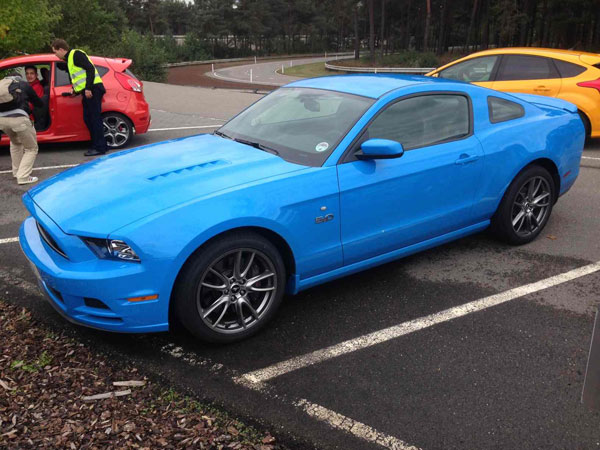
New Ford Mustang
Another will be the all-new Vignale, a luxury saloon, first unveiled at Frankfurt, which will hit European markets late next year, ahead of the long-awaited and long-delayed new Mondeo, now not expected to appear before early 2015.
Apart from benefiting from myriad technological innovations developed by Ford in recent years such as the well-documented ‘flick of the foot to open the tailgate’ device on the Kuga, to their Sync communications system, the company is also working on other ground-breaking concepts. And by the way their Sync system has now been upgraded to enable drivers to operate their favourite apps via voice control,
Addressing a gathering of European journalists in Lommel, where more than 400 personnel are involved in research and development, company executives also revealed that, among the benefits for Vignale customers, will be a new corporate approach to customer service. This includes a free car wash for the lifetime of the car!
It was “very likely”, they said, that under the new customer service blueprint, the customer would not have to drive to the dealership as the car would be picked up, washed and returned.
In addition, the Vignale customer would have a single contact at the dealership to deal with any issue on product or service, meaning that customers will always be able to talk with the same person.
The Vignale customer experience was about providing help not only for product and service needs, but also to assist with things such as booking a theatre ticket or finding a nearby parking space. And a range of top-notch promotions would also be offered to Vignale buyers.
The name Vignale refers to Italian coachbuilder Alfredo Vignale who founded his business in 1948 in Turin.
Ford expects that “Vignale-line” models will make up about 10 per cent of total European sales while, overall it will represent 5 per cent of the company’s sales on the continent.
As for price, Vignale-branded models will be about 10 per cent more expensive than Titanium, they said.

Company executives also confirmed that an “even more stunning S-Max”, a car which, they claimed, still had “no competition in its class”, was also on the way.
On the technology front, the My Key system which allows parents, for safety and driver behaviour reasons, to disable the car or place restrictions on speed and entertainment noise in a vehicle driven by their offspring, was being well received.
Meanwhile, research and development was continuing on Ford’s new fully remote automatic parking system, and on a new car-to-car communication system which would enhance safety and make a major contribution to traffic flow. Work also proceeds on two impressive ‘collision avoidance’ systems, both demonstrated on site during my visit., And Ford claims, they will will make the roads safer for all users, including pedestrians.
Under the latter system, compatible cars would be enabled to issue a range of warnings to each other on traffic and driving conditions, and when necessary, adapt to each other’s speed in busy or hazardous situations.
With the second safety system activated, the blushes and perhaps much more of the driver may be spared thanks to new alerts warning of the potential of a rear-end collision at speed. In the event of inadequate or no driver response to the imminent danger, the system will take full control of the car, monitor its positioning on the road and steer it past any obstacle to safety.
Ford designers and engineers are also in the process of creating a special ‘Cardio’ car seat which would be capable of monitoring a person’s heart rate and, in the event of an incident, issue a warning, transmit readings and details to and summon help from the patient’s physician or health centre.
Another device still being developed would enable a diabetic occupant, through a blow-tube to monitor their blood-sugar level, and warn of any impending danger. Additionally, if necessary, it will disable the engine and summon assistance.
The Lommel programme also included a spine tingling trip around the track at more than 150 mph in a 5-litre Mustang along with a series of short test drives in Ford’s expanding range of electric cars.
The future it seems, is already here.