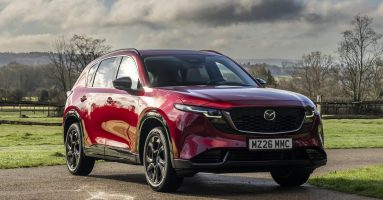
Dacia are stating the obvious – not just with the name of their latest family crossover but it is priced well below rivals.
It’s a given that this is a big car. So rather than spending time trying to find some fancy name for it, they went for the obvious. Welcome to the Bigster.
They anticipate lots of interest from budget-conscious families, in particular, for whom the smaller Duster is a tad too tight.

They will certainly find this to their liking as far as space goes. There is huge room at the back and an impressively big boot (677 litres, depending on model).
But the eye-catcher, initially anyway, is the starting price of under €30,000. It is also fairly decently equipped for a car of its size and price.
Rivals can claim that their spec levels would cost Dacia a good deal more if they had them into the Bigster.
There, of course, truth in that claim. But the Bigster is still a lot of car for the money. The hybrid version I had, and the one most likely to draw most attention I think, starts at €35,140 and ranges to the top-line Extreme at €37,840. Those models are well equipped into the bargain.
Dacia also see merit in telling second-hand owners that they can get a car of this size, with a three-year warranty, for around €30,000. That is the sort of psychological appeal they applied with the Duster when it was launched here in the middle of the Doldrum years. It helped get a lot of buyers, who knew a bargain when they saw one, into a Duster and out of a used car. The Duster has gone on to greater things. But isn’t it ironic that it should be a ‘stretched’ version of the Duster (the Bigster has the same CMF-B underpinnings) that is waiting for history to repeat itself in the mid-size family SUV market.
It is a tough segment wherein several household names compete. They include the likes of the Renault Austral, KIA Sportage, Toyota RAV4, Volkswagen Tiguan, Nissan Qashqai, Hyundai Tucson etc.
A lot has changed in the intervening decade or so and most cars in that bracket boast sumptuous trim and all sorts of electric gadgetry to woo buyers. But I still venture to suggest there are enough people out there who will overlook the stylistic downsides and rather run-of-the mill interior in favour of getting into a car like it.
It is not the prettiest car on the market. It is not adorned with special looks. Nor is it a sensational drive (though to its credit, it was much better on the road than I anticipated). And it isn’t bargain basement stuff in the interior but it does go heavy on the plastic to the detriment of soft-feel elements.
Nonetheless, there is good spec from the start. In all there are four trims: Essential, Expression, Journey and Extreme.
Entry-level spec (Essential), has 10.1-ins central touchscreen with Android Auto and Apple CarPlay, air con, 17ins alloy wheels, a parking camera as well as rear parking sensors. The other three trim levels (Expression, Journey and Extreme) get keyless entry, Multiview camera, front and rear parking sensors, dual zone climate control. Wheels (17ins, 18ins, 19ins) depend on the trim.
Journey and Extreme levels get heated front seats, rear-window privacy glass, wireless phone charging. An electric tailgate comes with the Journey models while an electric sliding panoramic roof is an Extreme item of equipment. There is also the option of a contrasting black roof (a mere €250), on Journey and Extreme trims. Not bad is it?
At 4.57m it is longer than some competitors and not far off most of the others. Its 2.7m wheelbase translates into above average leg, head and knee room though the car is relatively narrow so elbows might be touching in the back.
The rear seats fold 40:20:40 with a centre armrest when the middle seat isn’t occupied (and it is only for younger passengers while they can be folded by using a release lever in the boot.
They’ve gone for a spread of three engines. The TCe 140 is a revised TCe 130 and has 48v mild-hybrid technology. This gets a 6spd manual gearbox. And then there is the mild hybrid 130 4×4. The all-wheel drive system has a 6spd manual gearbox and a 48v mild hybrid set up with a 1.2-litre 3cyl turbocharged engine.
I had the model carrying the full hybrid badge. Dacia gets first go on this engine – it is Renault’s new hybrid 155. They claim consumption of as low as 4.6l/100km and I won’t dispute them because I found it quite good in that area.
Of course, it sips less in urban/traffic and like virtually every manufacturer with a hybrid car to sell, Dacia claims the Bigster can drive in all-electric mode up to 80pc of the time in city driving, which obviously reduces fuel consumption. It is a figure that hasn’t been contradicted but I’ve never come across it in real-world driving.
As I said I was surprised at how decent a drive it was. It took poor roads and a good old shake from a gouged section of tarmac without being out off-course. And there was little enough road noise to contend with; again this was surprising because large internal-volume cars tend to boom a bit when you accelerate or thud when you hit potholes or bulges.
The only drawback in my drives was the odd little ‘shunt’ from the transmission when the petrol engine and electric sources aligned their respective inputs.
Dacia can be sensitive about safety ratings under EuroNCap which is why they spell out a range of driving aids that come as standard. They range from lane change alert to traffic sign recognition and driver attention warning.
I’m always wary of making predictions about how a car will fare because tastes and trends can change quickly.
In the case of the Bigster it has to be said that not everyone will be taken by it. But sufficient numbers will make it a serious keen-price option. It is a car worth giving a test-drive to if you have or can get upwards of €30,000 or so.