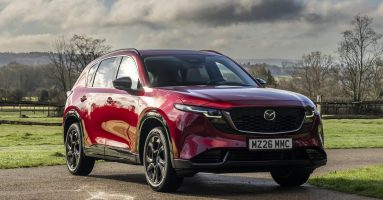
Volkswagen went to great rounds to make a mid-size SUV 7-seater to slot in between the larger Touareg and the Tiguan AllSpace. The only trouble is though they couldn’t stretch to a 7-seater in the new plug-in model version. On the face of it that sort of negates the reason for making the car in the first place. But there are compensating factors as we’ll see anon.
Basically the large battery of the plug-in Tayron took up too much space under the rear seats and boot-floor to accommodate a third row of seating. And there would have been issues with headroom, I think.
It’s a pity because the 7-seat Allspace Tiguan, for which the Tayron was made to replace totally, was really a tight fit and was much, much better as a five-seater.
All is not lost, however, as there is a trusty diesel that doesn’t have an intrusive larger battery in the Trayon line-up.

But the plug-in was the one that people were expected to plump for given its lower purchase price due to favourable VRT treatment of PHEVs, €140 road tax, and potential to return ridiculously low fuel consumption. The official figures cite usage of a mere 0.4-litres every 100kms. In reality on my drives, it managed around 4.7litres/100kms. The wide discrepancy between the two is largely due to the fact that the ultra-low figure is based on little more than a 30-minute drive, albeit in real world conditions.
There are still reasons for being enthusiastic about the 5-seater plug-in version. Volkswagen claim it can travel up to 126 kilometres (118 kms in the case of the car on test) without needing the 1.5-litre turbo petrol 208hp engine to come to its aid. I’m just saying that its driving range makes up for a lot. You could, with some care, drive up to 850kms without having to stop for petrol if you start out with a fully charged battery and a full tank (45 litres).
Links with the Tiguan are close. The new SUV is built upon the same foundations as the regular Tiguan; is a tad taller (1,688mm) and wider 1,853mm but it is around 25cm longer at 4,792mm. The wheelbase stretches to 2,788mm.
Cabin and boot space benefit. There was loads of room for my rear-seat passengers. The boot of 705 litres can be upped to 1,915 litres if you fold the rear seats.
There are three trims: Life, Elegance and R-Line. The Life model has 17ins alloys and a more straightforward front-end design look.
Elegance spec has 19ins wheels, silver anodised roof rails, chrome details at the front and rear privacy glass.
The R-Line range topper has a distinctly sportier look about it while a special edition R-Line 75, which I drove, had flamboyant touches and technical additions designed to enhance it as Volkswagen celebrates the brand’s 75 years in Ireland.
The range starts at €56,690 for the 2-litre TDi Life model. The eHybrid starts with mid-grade Elegance spec and costs from €57,590.
The eHybrid R-Line starts at €58,245 and the R-Line Edition 75 costs €60,145 – it adds metallic paint, panoramic sunroof, a head-up display, Park Assist with memory and Park Assist Pro.
Delivery and service charge comes to a sizeable €1,820.
The whole look of the car is Volkswagen through and through. The cabin borrows heavily from the smaller Tiguan. But that’s okay because had decent grade materials and plenty of style. And the range-topper showed what they can do to a car to make a motor look and feel upmarket.
A 10ins digital screen for the instruments is standard. But the upmarket move is underlined by the likes of the standard 12.9ins infotainment touchscreen being increased to 15ins in my test car.
And they have yielded to commonsense by placing physical buttons on the multifunction steering wheel rather than the much-criticised haptic touchpads that drove me, and many like me, stone mad betimes.
Then there is your digital voice assistant (IDA) with ChatGPT integration to answer your questions. There is a clever, practical storage area beneath which are two wireless charging pads in the centre console.
It’s a cabin I enjoyed driving on a long journey; excellent seating, soft materials, good visibility and little or no road noise, mostly. Except when I wanted to get a move on – that’s where I’d get a growl from the engine as it gathered itself to do some work.
And, for a large SUV, the handling felt quite sprightly. That is, in part, due to the presence of Volkswagen’s DCC Pro adaptive chassis control in the top spec. It works faster than the old version at detecting and lessening bumps and thumps, thereby reducing disturbance in the cabin.
As I said, the R-Line version with its 19.7kWh battery is capable of 118 kilometres of solo electric driving. I calculated (roughly) 90kms to be nearer the mark but, of course, it is all about how many passengers are on board, how fast you drive and brake and your general driving style.
The 85kW (115hp) electric motor had plenty of torque around town but at motorway speeds it was discernible how quickly the remaining charge was dissipating.
Spec on the test car in included 20ins alloys, adaptive cruise control, convenience package including Park Assist Pro, dynamic road sign display, headlight range control, panoramic sunroof, heated leather sports steering wheel with shift paddles, high beam control, winter package (heated front seats etc).
In summary, this is a substantial SUV with loads of room for five and their luggage. And it has the look and feel of a classy vehicle in its own right. It is a pity they couldn’t manage a 7-seat PHEV version. But, don’t forget, if you’re really stuck on a 7-seater, there is always the diesel.